Thursday, April 22, 2010

Sunday, January 17, 2010

Illuminating your Home with custom Glass Pendant Lights

Honestly how many times year do you go through your home and redecorate, remodel, or just destroy a part of your house in a do-it-yourself project? Sometimes these home decorating decisions tend to drag on for several months or even years in my case. Yet we love to make changes to our scenery regardless of the amount of work that is involved especially when trying to add personal touches to your home. The next time you decide to endeavor in such a process, try a simple 2 day project to create stunning and unique pendant lights. It is so easy a child could do it. To prove this, Slumpy’s invited some kids into the studio!

Step 1:

Prep your work station for this project. Our girls chose a clear blank in a 8” diameter. The size glass you should use is dependent upon the mold you choose and the desired effect. The girls decided to use Slumpy’s SS-905, Terrena. This mold measures 9” tall. The 8” diameter glass was used since they wanted a more organic and uneven drape that would not hit the shelf when fired. You are not limited to a circular design. We urge you to experiment with different shapes.

Step 2:

After you collect all your materials, like glass pebbles or glass frit, you are ready to start decorating your glass blank. Make sure to wear protective gloves and glasses. Please provide adult supervision if children are performing this project.

Tip: If using a circular blank you may find a radial or symmetrical composition is ideal for the design.

Step 3:

After you have finished designing your blank, clean up and prepare your glass to be fired. By brushing the edges of the glass, you can remove any overhanging glass pieces. This will ensure that you do not have any sharp points after you perform your full fuse. Lay down a fiber paper of your choice and fuse!

Tip: If you cut the paper close to the size of your glass, you can prevent the paper from rolling up on the edges of the glass.

Step 4:

After you perform the full fuse on your pieces, you are ready to drape your glass. Slumpy’s really wanted to redecorate our office so we designed molds specifically for pendant lights. We recommend that you use the new Armored Kiln Gear molds that have smaller bases intended for light fixtures. Our girls intentionally positioned their glass off center on their drape mold. But if that’s not the look you desire here you can always find the center of your glass. You will need to measure the diameter of you glass to find the center and mark it with a permanent marker. Don’t worry, it will fire away. Align the marked spot on the glass with the center of the drape mold. Another method is measuring the walls of your kiln to find the center where you will place your mold, then measure the distance of the glass edge to the walls of the kiln. The more you measure the more your piece will measure up!

After all that measuring you are ready to fire your piece. Slumpy’s urges you follow our ‘drape’ firing schedule but we understand if you have a favorite one you’d like to use.

Step 5:

When selecting your drill bit you will need to measure the socket of the light fixture you will be using. We used our 1” Diamond Drill bit and measure the glass base to find the center. Break out that permanent marker again and trace the drill bit so you do not lose your center mark. When drilling glass, you will need water constantly running over the area you are drilling. We attached a hose to our facet and positioned it over our glass. We then placed a clamp loosely on the hose to the side of our utility sink to secure it in place but not preventing water flow. Start drilling at an angle rather than perpendicular to the surface. By starting at an angle, you are minimizing the chances of the drill bit bouncing. Once you have a decent groove in the glass, slowly maneuver the drill into a 90° angle and continue drilling. The closer you are to completing the hole, slow down the speed of your drill to avoid chipping.

Step 6:

Assemble all components of your light fixture including your glass drape. Depending on the type of fixture you purchased, you may require an electrician to complete the wiring. Our girls used a recessed light conversion kit so all they had to do was screw in the fixture to a preexisting socket
light.

Step 7: (optional)

Have a party and impress your friends!

More and more people want do-it-yourself projects for the feeling of accomplishment and not to mention the relief on the wallet. Slumpy’s carries a full line of easy to install pendant light kits at affordable prices and in a variety of finishes to suit your design taste! Spring cleaning is coming up soon so refresh your home with this simple and easy project and checkout Slumpy’s Armored Kiln Gear for your glass draping molds needs.

Tuesday, December 29, 2009

What kind of primer should I use on Stainless Steel Molds?

This month, Slumpy's has had many questions about what kind of primer to use and what steps are needed when priming a stainless steel mold. Since we are getting close to unveiling many new additions to the Armored Kiln Gear line, I figured why not write down some tips.

One method (I refer to as a past method because I no longer have the patience or time to perform this) requires you to heat the mold and then brush on the kiln wash in thin even coats. Of course with any application you must wait for it to dry in between applications. If the primer just drips down your shape, increase the temperature to get it to stick. When using the kiln wash, you need to apply several coats, covering any and all surfaces where your art glass comes into contact. Many recommend you mix 20% rubbing alcohol to 80% water you mix with your dry kiln wash powder. Adding rubbing alcohol into your mixture will allow it to evaporate faster so you don’t have to wait as long for it to dry when brushing on an application.


Another method, which is what I prefer to use, is using the boron nitride sprays. It just works so much faster and there is less mess! I am a messy artist so this appeals greatly to me in my effort to have a clean studio. With the boron nitride sprays, you are not required to heat the mold prior to application. Take your mold to a well ventilated area, shake container well before application, and hold can 6-8 inches away from mold surface spraying on a light coat. Let layer air dry before applying another coat. Continue until you have 3-4 light coats of primer. You should able to see the a dull gray of the steel under the Boron Nitride EP Spray. The Boron Nitride Spray II produces a thicker white coating. When the Boron Nitride Primer is completely dry you are ready to use the mold or you can cure it. If you want to cure the mold set our kiln to 200°F (93°C) and let soak for four hours, then increase your temperature to 1300°F (700°C) this will make the finish hard and last longer.

Both methods can be touched up easily with another few applications of wash/boron nitride spray. You may want to apply another application when you see areas that are scratching off.

In 2010, Slumpy's will add to the popular glass draping molds, the AKG line. We have been designing many new shapes that we are very excited about. So if you are going to try out one of our new stainless steel molds, keep these priming methods in mind. And as always feel free to contact us at slumpysartist@slumpys.com or 1.866.SLUMPYS

Happy Slumping!

Thursday, August 13, 2009

New Stainless Steel Mold test.

Slumpys designs new molds on a monthly basis. Before we bring in new molds, we get a sample in and run several tests on them. We recommend you follow Slumpy's firing schedule and prepare to adjust the firing program as needed for your specific kiln, size of project, and type of glass. We use our schedule to test our molds and change the temperature for a deisred result.

The glass vase (right) was made from a new stainless steel mold. The glass was two layers thick and 11.5 inches in diameter. The fused glass was then draped over the molds using Slumpy's Slumping firing schedule with a modification to the fourth segment taking the temp up to 1280°F. The vase sits flat without rocking and our mold held up to all the firing schedules inflicted! Look for this new shape later this year! Happy Slumping from your pal Slumpy's!

New Arrivals to the Amored Kiln Gear line

As the world’s leading innovator and supplier of glass slumping and fusing molds, Slumpy’s is very pleased to announce the addition of several new shapes and sizes to our Armored Kiln Gear Line. Slumpy’s new stainless steel collections include everything from tall cylindrical forms to square vases and sleek contemporary shapes. These new molds range in size from 8 to 18 inches tall and create very dramatic finished pieces. The feedback we received about these new forms at the Las Vegas Glass Craft & Bead was very positive and exciting.

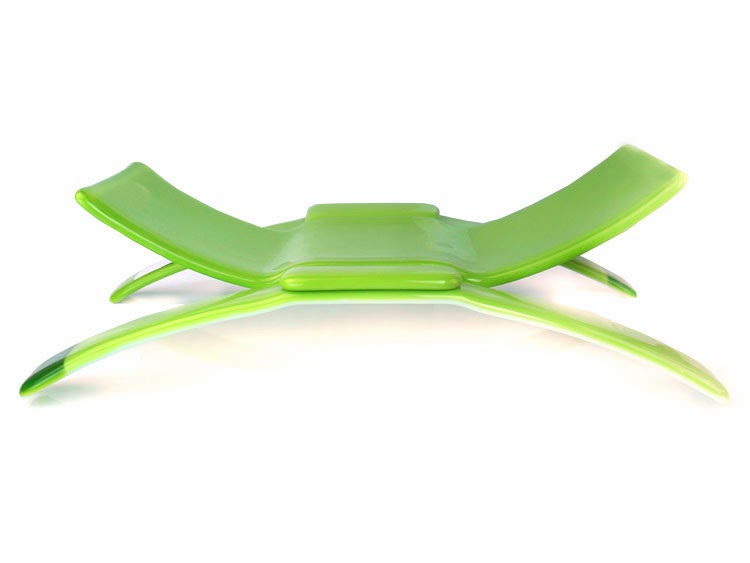
In addition, we are constantly updating our clay molds with new designs in various shapes and sizes. And expanding our product line to include items such as fiber rolls measuring 10’X2’, stands to display finished art pieces and a wide selection of hangars, primers, glues and tools.

Be sure to visit Slumpys to see the most recent arrivals. At Slumpy’s you will always find quality products at great prices. We stand behind our products 100%.

Tuesday, July 21, 2009

Slumpy's Joins Blogger

Slumpy's the glass mold company has created a blog to document all the glass mold testing we do and our results to help other warm glass artists use our molds. We will also update our new arrivals to slumpys.com!